Hedge Fund vs Traditional Investment

Christopher Mills
July 24, 2026

Upfront, I'd like to say that I'm no expert in hedge funds and this is a relatively new area to me. However, I've received several questions about hedge funds so after doing some research, I felt that it would be worthwhile to share my findings with all of you. I don't think hedge funds are for everyone, and I personally, don't invest in a hedge fund so please keep this in mind whilst you read through this.

Introduction

Firstly, a hedge fund is called a hedge fund because the word, "hedge" was originally used to refer to reducing investment risk by holding positions that offset one another. In modern hedge funds, though, many different strategies are used, some of which take on considerably more risk than others.

A traditional investment fund generally buys assets such as shares or bonds, and makes money when those assets rise in value or generate income. This is the typical approach most of us use when we buy ETFs.

A hedge fund pools investors' money and then invests accordingly. However, the manager of the fund has a wider toolkit and greater flexibility. The objective is often to generate positive returns or reduce losses across different market conditions, rather than simply tracking the stock market.
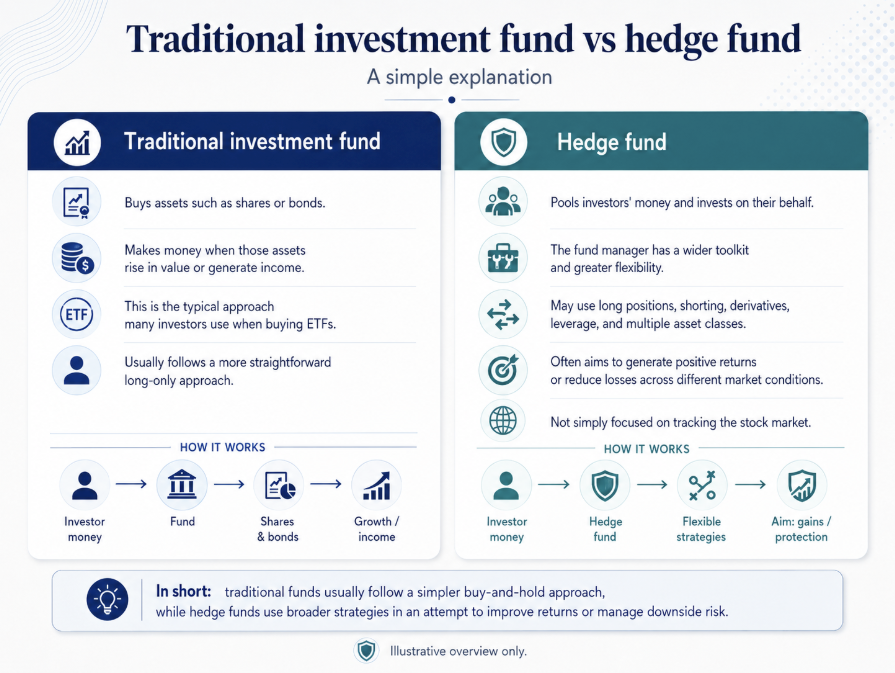
Fund Comparison

One thing that immediately caught my eye was the flexibility of a hedge fund, whereby the manager of the fund may:

  • Buy investments that he/she expects to rise, which is known as going long.
  • Short investments that he/she expects to fall. Meaning, borrowing and selling an asset, in hopes to repurchase it at a lower price.
  • The manager may use derivatives, such as future or options to hedge risks or take market positions.
  • Use leverage, which is borrowing money or to increase exposure..
  • He/she may trade across different assets such as shares, bonds, commodities and currencies.

This flexibility is very different to what a traditional investment fund looks like, and this does present great opportunity but, for me, it all boils down to the aim of the hedge fund, the track record, who the fund manager is and so forth. Not only would you be looking at a single company or ETF, like usual, but now you have far more to consider. To me, that introduces more risk. I say that from a personal point of view because on the flip side, having a great manager with more flexibility could most certainly result in greater gains or reduced loses.

Here's what I could put together from a comparison point of view:

Hedge Fund vs Traditional Fund

Absolute vs Relative Returns

When it comes to a traditional equity fund, for example, they're usually judged relative to a benchmark. If the market falls by 10% and the fund by 5%, it has outperofrmed its benchmark, even though the investor lost money. However, a hedge fund may persue an absolute-return objective, such as generating a positive return over time or outperforming cash by a stated margin.

What this means is that with a hedge fund, one needs to understand the objective, and that it's not as straight-forward as comparing against a market move.

An Example

I learn through examples, so let's look at an example:

Suppose the stock market falls by 10%:
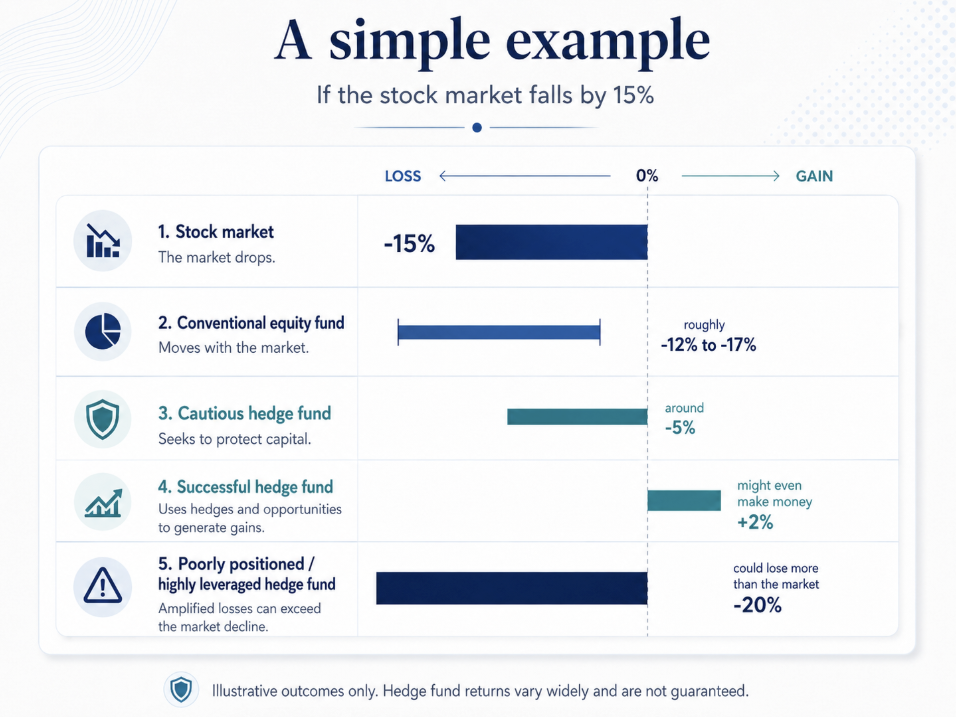
  • A conventional equity fund might fall by roughly 8 to 12%, depending on what it holds.
  • A cautious hedge fund might fall only 5% because it had short positions or other protection.
  • A successful hedge fund might even make money.
  • A poorly positioned or highly leveraged hedge fund could lose more than the market.

Hedge Fund Potential Performance

I included this graphic on purpose because at a quick glance, it makes one think that a hedge fund is perfect, it loses less when markets are down and makes more when markets are up. That's a perfect recipe but that is most definitely not the case and one needs to be incredibly careful that what a hedge fund manager says about performance. At the end of the day, you're still entrusting a manager with your money and a manager is a human and humans make mistakes. Couple that with leverage and a hedge fund can most definitely result in far greater losses than a typical investment.

One way would be to look at it like this: The aim is therefore not necessarily spectacular returns. A well-designed hedge fund may be intended to produce smoother returns, lower market dependence and smaller drawdowns.

Types of Hedge Funds

Now that we've covered the introduction and an example, I felt it would be a good idea to outline some of the different hedge fund strategies that are used:

  1. Long-Short Equity: Buying shares expected to rise and shorting those expected to fall.
  2. Market Neutral: The balancing of long and short positions with the aim of focusing more on stock selection performance.
  3. Fixed-Income or Credit: Trading bonds, interest rates and the differences in credit pricings.
  4. Global Macro: Positions taken against a broader view of currencies, interest rates, comodities and economies.
  5. Event-Drive: A focus on mergers, restructurings, brankrupcies and various corporate events.
  6. Multi-Strategy: A combination of the other strategies pulled together.

This is important because comparing two hedge funds is definitely not like comparing apples and apples.

Fees

Fees, fees, fees, arguably one of the most important concepts to understand in investing. A 2% fee might sound small, but compounded over years turns out to be a massive drain on your investment. We've spoken about this substantially on 100MPM. Now, with hedge funds, let's see what's going on:

Firstly, one needs to accept that fees can differ substantially from one fund to another. There are many fees that funds leverage:

  1. Annual management fee: This is the ongoing fee charged for managing the fund. It is usually calculated as a percentage of the amount invested or the fund’s net asset value and is normally payable whether the fund makes or loses money.
  2. Performance fee: This is an additional fee paid to the manager when the fund generates investment gains. It is usually calculated as a percentage of the profit, although the exact method differs between funds.
  3. Performance calculated before or after costs: Investors should check whether the performance fee is calculated on returns before deducting management fees and other expenses, or only after those costs have been deducted. A fee calculated on gross returns will generally be higher than one calculated on net returns.
  4. Hurdle rate: This is the minimum return the fund must achieve before a performance fee becomes payable. For example, a fund may need to earn more than 5% before the manager can begin charging a performance fee.
  5. High-water mark: This is the highest previous value on which a performance fee has already been charged. It is intended to prevent the manager from charging another performance fee simply because the fund recovered from an earlier loss.
  6. Performance fees after a previous loss: This depends on whether the fund uses an effective high-water mark. Without one, a manager could potentially charge a performance fee during a profitable period even though the investor is still below an earlier peak. With a high-water mark, earlier losses generally need to be recovered before another performance fee can be charged.

Let's look at an example, and compare a traditional investment to a hedge fund in light of fees:

Let's imagine we invest R1,000,000 into a traditional investment and R1,000,000 into a hedge fund, here are examples:

Traditional Investment Fund

  • The fund earns a gross profit of R100,000, taking the investment from R1 million to R1.1 million.
  • A 1% management fee amounts to approximately R10,000.
  • The investor therefore finishes the year with approximately:
  • R1,100,000 − R10,000 = R1,090,000

The investor’s net gain is R90,000, equivalent to a return of approximately 9% after fees.

Hedge Fund Investment

  • The hedge fund also earns a gross profit of R100,000.
  • Its 1.5% management fee amounts to approximately R15,000, reducing the profit after the management fee to R85,000.
  • The first 5% of the return—equal to R50,000—falls within the hurdle rate. The amount above the hurdle is therefore:
  • R85,000 − R50,000 = R35,000
  • The manager charges a 20% performance fee on this R35,000:
  • 20% × R35,000 = R7,000
  • The investor therefore finishes the year with approximately:
  • R1,100,000 − R15,000 − R7,000 = R1,078,000
  • The investor’s net gain is R78,000, equivalent to a return of approximately 7.8% after fees.

This example does not mean that traditional funds are always better. It simply shows that when two funds produce the same gross return, the hedge fund’s additional fees may leave the investor with less.

The hedge fund would need to produce a higher gross return, provide better downside protection or offer meaningful diversification to justify the additional cost. This is why hedge-fund performance should always be assessed after all fees, rather than relying on the headline return.

Actual fee calculations can be more complicated. Management fees may be calculated throughout the year rather than only on the original investment, while performance fees may use different hurdle, high-water-mark and expense arrangements.

Withdrawal

Something else I came across which is critical to understand is how you'd withdraw money from a hedge fund. With a traditional investment, your money is readily available - in worst case scenarios, you might have to wait a few days but with hedge funds, this can be very different.

Hedge funds often come with money withdrawal blockers such as:

  • monthly or quarterly dealing dates
  • notice periods
  • minimum holding periods
  • lock-ups
  • etc.

It is absolutely crucial to understand how the fund works that you're interested in as you might find that you won't be able to get your money out easily, or quickly.

DD

Due diligence, the most important matter when it comes to any form of investing, and for hedge funds, it's no different at all. You need to ask the questions that get you the answers in order to make an informed decision.

  • What is the fund trying to achieve?
  • What conditions might result in a loss?
  • What are the ideal conditions?
  • What is the maximum leverage?
  • What was performance like during difficult markets?
  • What are all the fees associated with the fund?
  • Who manages the fund?

There are many other questions, but these come to mind based on what's been written in this article. Do not rush, gather the information you need, please.

Final Thoughts

Having spent time researching this, investing some funds and reaching out to colleagues, my take is that a hedge fund is definitely a viable option, but not for everyone but rather those who are more experienced and more informed. I read through a number of papers from some hedge funds that I could get hold of and after that, it left me thinking that I'd probably give this a miss and focus on what I know does work. At this point in time, at least.

Christopher Mills

I run a successful agency, my other passion is personal finance.

Join The Newsletter

Other posts

you might like:

glasssearchheartusermoneyquestionnewspaper-oline-chart

linkedin facebook pinterest youtube rss twitter instagram facebook-blank rss-blank linkedin-blank pinterest youtube twitter instagram